

By Lisa Bollow, MA, LPC-R, NCC®, EMDR PT-I®
Founder, The Integrated Life Project
I’m fascinated by the relationship between sleep architecture, emotional regulation, and cognitive performance. In clinical practice, I assess sleep quality and its psychological implications; in my work with high-performing individuals, I examine how disrupted sleep, heightened vigilance, and other physiological stressors consume the cognitive resources needed for clear thinking, effective decision-making, and sustained performance.
Though this study focused on older individuals, it highlights the importance of sleep quality on cognitive function that can inform future work with other populations.
When most of us talk about how well we slept, we talk how long we slept.
Did you get seven hours? Eight hours? Did you go to bed early enough?
But total sleep time tells us only part of the story. The architecture of sleep, how deeply and continuously the brain moves through different sleep stages, may be equally important.
A recent study published in Communications Psychology suggests that reductions in slow-wave activity during non-REM sleep may help explain why some older adults experience greater anxiety the following day. The findings expand how we think about deep sleep: not only as a period of physical restoration and memory consolidation, but also as part of the brain’s overnight emotional-regulation process.
What the Researchers Examined
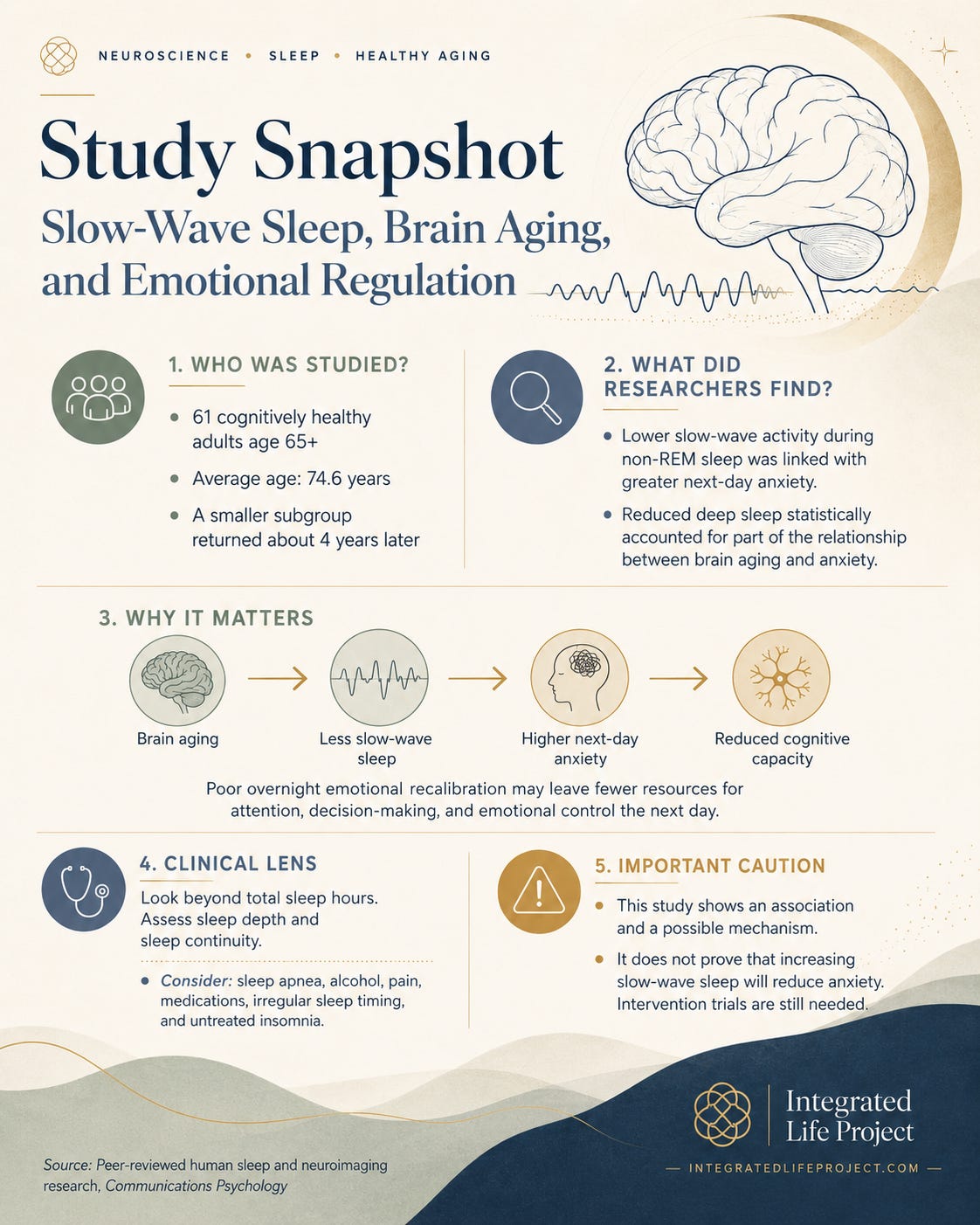
The study included 61 cognitively healthy adults over age 65, with an average age of approximately 75.
Participants completed two nights of laboratory-based sleep monitoring. Researchers used polysomnography, including EEG recordings, to measure slow waves during non-REM sleep. Participants also completed measures of state anxiety before sleeping and again the following morning.
Structural MRI scans were used to examine gray-matter volume in brain regions involved in anxiety and emotional regulation, including the amygdala, insula, cingulate cortex and parahippocampal regions.
A smaller group of 24 participants returned for follow-up assessment approximately four years later, allowing the researchers to examine changes in sleep and anxiety over time.
What the Study Found
Older adults (74.6 years average) with fewer slow-wave events during non-REM sleep reported greater anxiety the following day.
This relationship remained significant even after the researchers accounted for factors such as age, gender, trait anxiety, total sleep time, sleep efficiency and the amount of REM sleep participants received.
The findings were particularly evident during stage N2 non-REM sleep. Participants who generated more slow waves during this stage tended to experience better overnight anxiety regulation.
The neuroimaging findings added another layer.
Greater atrophy in regions associated with anxiety and emotional regulation was linked to a reduced capacity to generate slow waves. In turn, reduced slow-wave activity was associated with greater next-day anxiety.
A statistical mediation analysis indicated that impaired slow-wave activity accounted for the relationship between regional brain atrophy and disrupted overnight anxiety regulation. In other words, brain aging may affect emotional stability partly by interfering with the neural activity that supports restorative deep sleep.
Deep Sleep May Help the Brain Recalibrate Emotion
Sleep is sometimes treated as a passive state in which the brain simply shuts down for the night.
It is more accurate to think of sleep as an active period of neurological maintenance.
During slow-wave sleep, the autonomic nervous system typically shifts away from dominant sympathetic activation and toward greater parasympathetic regulation. Activity within prefrontal and limbic networks also changes in ways that may support the regulation of emotional arousal.
When this process works effectively, the brain may emerge from sleep with less emotional activation than it carried into the night.
When slow-wave activity is reduced, that recalibration may be incomplete.
The person may awaken physiologically rested enough to begin the day but remain more emotionally reactive, vigilant or anxious than they otherwise would have been.
Why This Matters for Cognitive Capacity
Anxiety is not only an emotional experience. It also places demands on cognition. This is an important fact to consider regardless of age. I see this in my work with high-performing individuals and in practice with clients.
Heightened vigilance requires the brain to continuously scan for possible problems. Worry occupies working memory. Threat monitoring competes with the attentional resources needed for planning, problem-solving and flexible decision-making.
This means that impaired overnight emotional regulation can influence much more than mood.
It may reduce the cognitive capacity available for:
Sustaining attention
Filtering irrelevant information
Making complex decisions
Regulating impulses and emotional reactions
Shifting perspective
Recovering after stress
Communicating clearly under pressure
For older adults, these effects may be especially consequential. A day that begins with elevated anxiety may require substantially more neurological effort to navigate, even when no obvious external stressor is present. How this presents in older adults can often look like cognitive decline.
Sleep Assessment Should Go Beyond Total Hours
The clinical implication is not that everyone needs to begin tracking specific sleep stages with a wearable device. Consumer devices estimate sleep architecture and cannot provide the same information as clinical polysomnography.
The more useful implication is that sleep assessment should not stop with the question, “How many hours are you sleeping?”
It should also explore:
Whether sleep is continuous or repeatedly interrupted
How refreshed the person feels upon waking
Whether anxiety is consistently higher in the morning
Snoring, gasping or other signs of sleep apnea
Pain or physical discomfort during the night
Alcohol use, particularly close to bedtime
Medications that may alter sleep architecture
Irregular sleep and wake times
Restless legs or nighttime movement
Persistent insomnia
Daytime sleepiness despite adequate time in bed
Public-health guidance similarly distinguishes sleep quantity from sleep quality. Repeated awakenings, difficulty initiating sleep and continued fatigue after an apparently adequate night can all signal poor-quality sleep or an untreated sleep disorder. Illness, pain, medications, insomnia and sleep apnea are particularly relevant considerations in older adults.
What the Study Does Not Prove
The findings are clinically meaningful, but they should not be overstated.
Most of the primary analysis was cross-sectional. This means researchers identified relationships among brain structure, slow-wave activity and next-day anxiety, but they did not experimentally manipulate slow-wave sleep.
The smaller longitudinal component provides preliminary evidence that declining slow-wave activity is associated with increasing anxiety over time. However, the study does not prove that increasing slow-wave sleep will directly reduce anxiety.
Anxiety and sleep also operate bidirectionally.
Important to remember: poor sleep may increase anxiety, while daytime anxiety and physiological arousal may make it more difficult to obtain stable, restorative sleep. Over time, these processes can become self-reinforcing.
Intervention studies will be needed to determine whether treatments that improve slow-wave activity produce measurable improvements in emotional regulation.
The Larger Takeaway
The most important message is not that deep sleep represents a simple cure for anxiety.
It is that emotional regulation is not solely a daytime psychological task.
The brain continues regulating, integrating and recalibrating emotional experience while we sleep. When the depth or continuity of that sleep becomes disrupted, the effects may appear the next day as anxiety, irritability, reduced attentional control or diminished cognitive flexibility.
In later life, protecting sleep quality may therefore be one component of protecting emotional and cognitive functioning.
Sleep is not time removed from performance.
It is part of the neurological process that makes clear thinking, emotional steadiness and adaptive functioning possible the following day.
Lisa Bollow is a therapist, neuroscience-informed performance strategist, and founder of Integrated Life Project. Her work examines how nervous system regulation, emotional clarity, and cognitive capacity shape leadership, decision-making, well-being, and sustainable performance, integrating clinical insight, neuroscience, and practical strategies for high-functioning individuals and leaders.

Connect With Me
Read more on Substack: https://integratedlifeproject.com
Connect on LinkedIn: https://www.linkedin.com/in/lisagoodwinbollow
View my Psychology Today profile: https://www.psychologytoday.com/profile/1572857
Research source: Ben Simon, E., Shah, V. D., Murillo, O., Zsofia, Z., et al. (2026). Impaired slow-wave sleep accounts for brain aging-related increases in anxiety. Communications Psychology, 4, Article 34.
This article is for educational purposes and does not provide medical diagnosis or individualized treatment recommendations. Persistent sleep disruption, morning anxiety, excessive daytime sleepiness, snoring or nighttime breathing difficulties should be discussed with a qualified healthcare or sleep-medicine professional.